By Evan Coffey
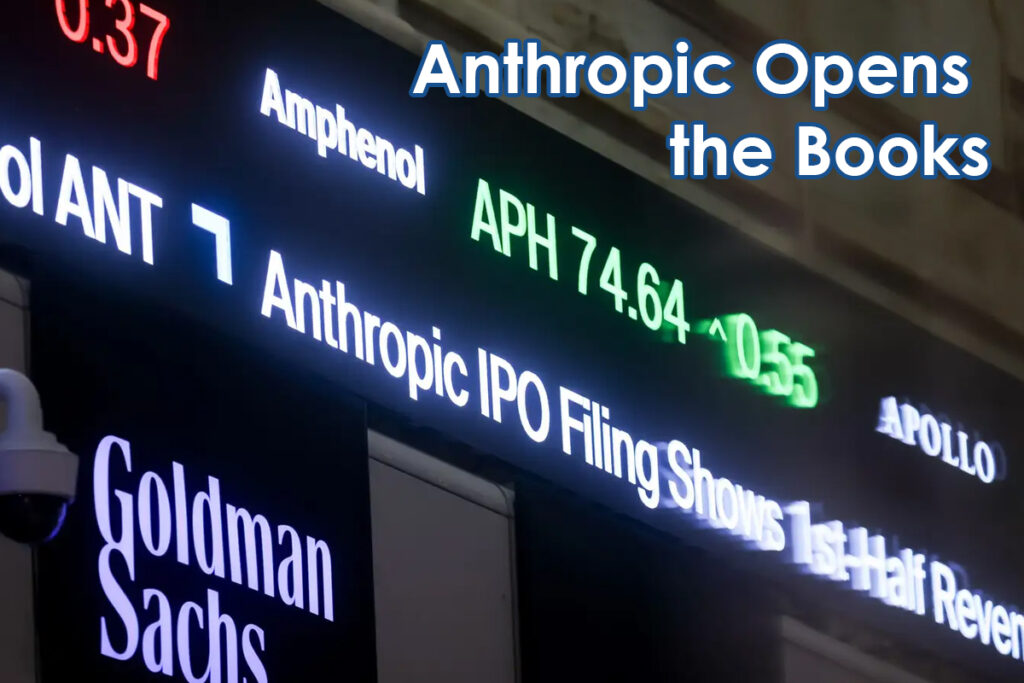
In May, Anthropic was privately valued at $965 billion. Next month, public markets may be asked to pay close to $2 trillion. On October 26th the company filed its S-1 to list on the Nasdaq under the ticker symbol ANT, with Goldman Sachs and Morgan Stanley leading a deal reportedly slated for Thanksgiving week. At that valuation, it would potentially rank as the largest listing ever, five months after SpaceX peaked at roughly $1.77 trillion.
Until now, the private AI trade has been priced using funding round data and run rate claims. The S-1 is the first audited look inside a frontier AI lab, and in my opinion, it complicates the bull and bear cases. The revenue is real, and the operating business just turned a profit, but the obligations behind it are measured in hundreds of billions of dollars, and most of them cannot be cancelled.
Revenue in Context
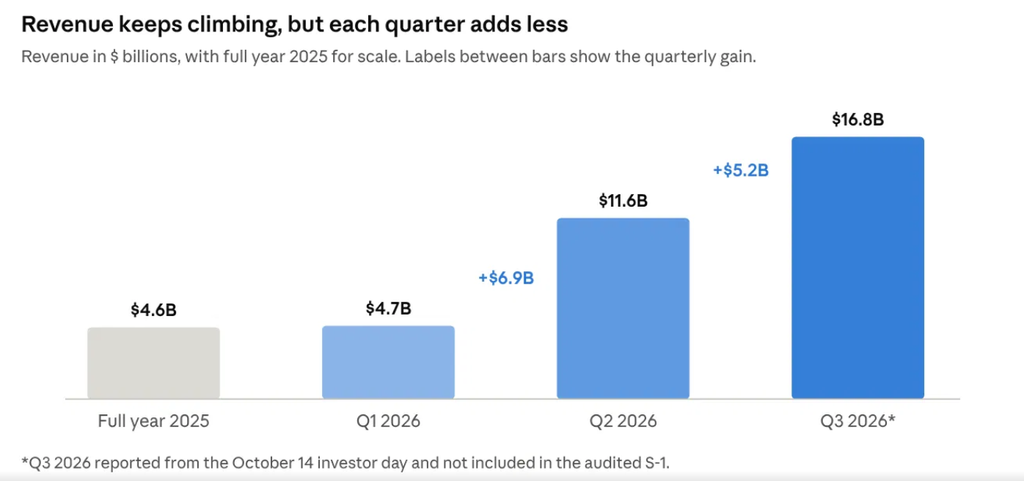
Revenue came in at $386 million in 2024 and $4.6 billion in 2025. The first quarter of 2026 alone, at $4.7 billion, exceeded all of 2025. The second quarter reached $11.6 billion, bringing first half revenue to $16.3 billion against $1.16 billion a year earlier.
The third quarter was reportedly the strongest in the company’s history and the first to show growth losing pace. Anthropic told prospective investors on October 14th that revenue reached $16.8 billion, a figure that came from the investor day rather than an audited filing. Sequential growth slowed from roughly 147% to roughly 45%, and the dollar increment shrank from about $6.9 billion to about $5.2 billion. A 45% quarter at this scale is extraordinary by any normal standard. It is also the first evidence that the curve bends, and the roadshow will be priced on how sharply.
Two Losses, One Business
The headline number is an $80.7 billion net loss for the first half. About $72.4 billion of the loss is a noncash charge reflecting the rising value of convertible notes and similar instruments. In practical terms, the company’s own appreciation is being marked against its income statement.
The operating line tells a different story. The first half operating loss narrowed to $693 million from $2.14 billion a year earlier, and the second quarter produced $974 million of GAAP operating income, the first operating profit among the six quarters disclosed. Operating cash flows for the first half was a positive $3.93 billion. Management also gave an adjusted figure which came out to $1.6 billion of first half operating income at about 10% margin. This excluded stock compensation, noncash charitable contributions and legal settlements so it deserved some level of skepticism, typical for adjusted measures.
The more durable signal is unit economics. Second quarter compute spending of $5.6 billion supported $11.6 billion of revenue, or $2.08 for every compute dollar, up from $0.40 in the first quarter of 2025. Reports from the investor day cite a third quarter ratio of $1.70. If the two measures are defined in the same way, compute spending grew faster than revenue last quarter, a detail worth watching as the growth rate starts to normalize.
Who Pays and Through Whom
Nearly half of 2025 revenue, about $2.16 billion or 47%, arrived through the Amazon and Google cloud marketplaces, up from 11% in 2023. Anthropic records those sales gross because it sets the price and delivers the service. OpenAI has argued the practice inflates reported revenue by billions. Two unnamed customers each contributed 12% of 2025 revenue, and two clients accounted for roughly a fifth of first half sales.
The result is the same circular set of relationships that has been discussed countless times by our team and the rest of the investment community. Amazon and Google are simultaneously Anthropic’s investors, its largest suppliers, its biggest distribution channels and its direct competitors. The S-1 itself flags that this arrangement could create conflicts over access to compute.
The Commitments
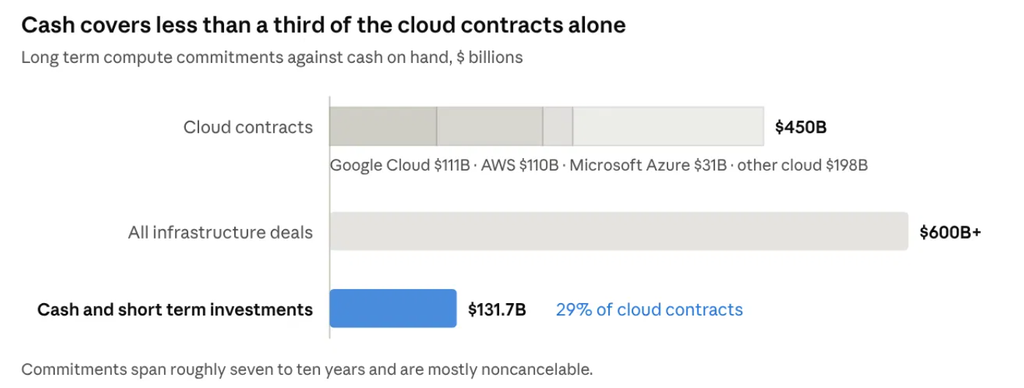
The filing’s most consequential disclosure sits off the income statement. To train and run its models, Anthropic has signed contracts to buy computing capacity, meaning the chips, servers, power, and data center space behind Claude. It owes roughly $450 billion under cloud agreements over the next seven to ten years, including about $111 billion to Google Cloud, $110 billion to Amazon Web Services, and $31 billion to Microsoft Azure. Chip leases, Nvidia capacity from Nscale and Lambda, and a $50 billion data center build with Fluidstack take total commitments past $600 billion, with up to $150 billion more under negotiation.
These are dollar obligations, and the largest of them behave like take or pay contracts, since the Google, Amazon, and Microsoft agreements are payable regardless of actual usage. Most of the money has not yet been spent because it comes due over the life of the contracts as capacity comes online. Revenue, by contrast, is overwhelmingly consumption based, and the filing acknowledges that many of its largest customers are not bound by long-term contracts. That is operating leverage in both directions, with fixed future bills set against variable revenue. The balance sheet offers a cushion, with $131.7 billion in cash and short-term investments, though that covers less than a third of the cloud contracts alone.
The Governance Question
Public shareholders will have very little control or say in how the frontier AI lab is run. The shares sold in the IPO are Class A stock, the only class an everyday investor will be able to buy. Anthropic remains a Delaware public benefit corporation. A founder LLC controlled by the seven cofounders will direct a single class F share carrying 50.1% of the vote on major decisions, while the Long-Term Benefit Trust, whose trustees include Ben Bernanke, elects four of the seven directors. Class A holders vote alongside the Class F share on the remaining three seats. The prospectus states plainly that mission driven decisions could harm the value of the Class A stock.
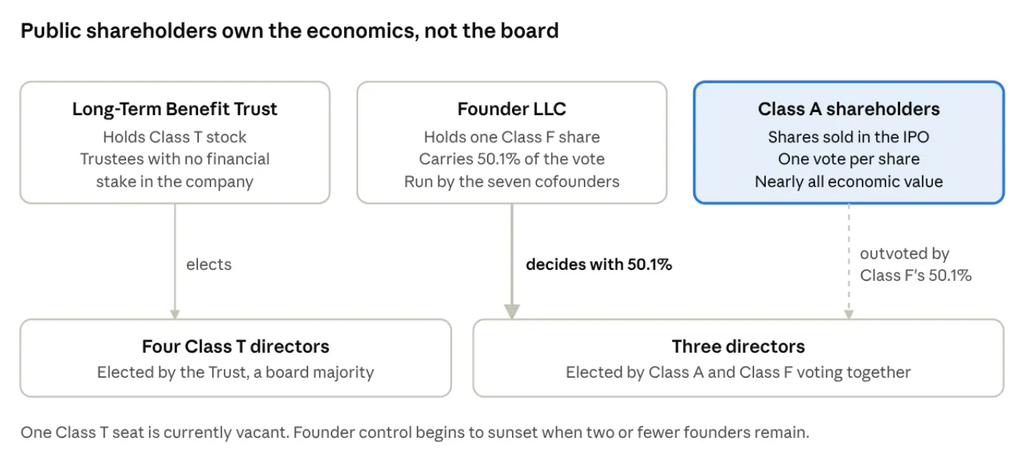
The structure borrows from that of Palantir, whose founders held up to 49.999999% of voting power, but goes one step further by crossing the majority line and layering a financially disinterested trust on top. Each cofounder owns roughly 2% and has pledged 80% of personal holdings to charity. I’ll leave it the reader to determine whether that reads as credible safety commitments or a governance discount.
What the Filing Means for Markets
For the broader market, the S-1 is as much a document about the AI supply chain as about one particular company going public. Anthropic’s commitments are, from the other side of the ledger, backlog for Google, Amazon, Microsoft, and Broadcom. This supports the idea that AI infrastructure demand is contracted rather than speculative, while concentrating counterparty risk on a single buyer whose GAAP operating profit is one quarter old.
As for valuation, $2 trillion is roughly 43 times second quarter revenue annualized and about 30 times the third quarter figure annualized. Investors reportedly expect an annualized run rate near $110 billion by year end, which would bring the multiple down to about 18 times. The gap between those multiples is the debate and at this price, buyers are not paying for the third quarter to be a pause in growth. They are paying for growth to pick back up.
The distribution is being built for that bet. According to Bloomberg, which cited people familiar with the matter, Anthropic tapped JPMorgan to lead US sales to individual investors, with Jamie Dimon expected to take part in the campaign, while Citigroup coordinates the international retail offering. The company has weighed allocating 15%-20% of the shares to retail buyers. JPMorgan ran the same assignment for SpaceX’s $86.2 billion IPO earlier this year, which reportedly drew more than $100 billion of demand from individuals. A retail tranche of that size broadens the shareholder base, and it also places a meaningful slice of the float with holders who own the economics but have very little say in how the company is run.
The S-1 does not settle whether frontier AI economics work. It moves the question from whether the revenue is real, which the audited statements pretty much take care of, to whether it can stay ahead of commitments that do not flex. Between now and pricing, the items to watch are the price range itself, audited third quarter results, the lockup structure, and whether customer concentration pulls back as the base broadens.
Evan Coffey | Investment Analyst, Asset Management
Evan is an Investment Analyst on GVA’s Asset Management Team. He specializes in investment research and has a passion for finance and economics. Evan uses his strong work ethic and financial literacy to help manage GVA’s multi-asset portfolios, mitigate risk, and help coordinate wholesaler relationships. In the Spring of 2024, Evan graduated as valedictorian from Ursinus College with a BA in Finance and a minor in Management Studies. Evan took part in Finance Scholars and was a CEO of the Ursinus College Investment Management Company. Evan was also inducted into Phi Beta Kappa and Omicron Delta Epsilon during his time at Ursinus. Outside of his coursework, Evan was captain of the men’s golf team and worked on a year-long honors project focusing on the stock-bond correlation and how macroeconomic variables affect the relationship between the two asset classes.
Prior to joining GVA full-time, Evan interned with GVA’s Asset Management team! During his time as an intern he focused on equity research, and shadowing wholesaler and advisor meetings. Under the guidance of the GVAAM team, Evan gained quality professional experience in the finance and asset management industry. Outside of Finance and Economics, Evan enjoys golfing, watching Formula 1 racing, going to Sixers games, and traveling with close friends and family.
Disclosure: I/we have no stock, option, or similar derivative position in any of the companies mentioned, and no plans to initiate any such positions within the next 72 hours. I wrote this article myself, and it expresses my own opinions. I am not receiving compensation for it. I have no business relationship with any company whose stock is mentioned in this article.
Investment advice offered through Great Valley Advisor Group (GVA), a Registered Investment Advisor. I am solely an investment advisor representative of Great Valley Advisor Group, and not affiliated with LPL Financial. Any opinions or views expressed by me are not those of LPL Financial. This is not intended to be used as tax or legal advice. All performance referenced is historical and is no guarantee of future results. All indices are unmanaged and may not be invested into directly. Please consult a tax or legal professional for specific information and advice. LPL Compliance Tracking #1200427
The economic forecasts set forth in this material may not develop as predicted and there can be no guarantee that strategies promoted will be successful. All investing involves risk including loss of principal. No strategy assures success or protects against loss.